assetApproxSize function
searchQuery string Search query to apply on list of all files in the workspace. See fileSearch / filesSearch for details about the syntax.
axisSize string
| "x", "y", "z", "xy", "xz", "yz", "xyz" | Axes for the currect scope. |
n float Number (integer >= 1) of possible returned result strings (1 returned randomly out of n possibilities)
Returns an asset with one of the best n size fits (according to axisSize).
This function returns one of the n best size fitting assets, from the files specified by searchQuery, according to the specified axisSize string.
Related
Examples
Inserting assets based on their (physical) size
The goal is to insert assets from a pool, depending on their (physical) size. The pool of assets is seen in the following image. Colors are (only) used to visually emphasize the size ratio.

Note the geometry variations in the next 3 images by using only the n parameter.
Note that small parts get blue assets while large parts get red assets.
n=1: "best fit"

Lot -->
    s('0.9,'0.9,'0.9)
    center(xz)
    RecursiveSplit

RecursiveSplit -->
    case scope.sx >= 1.5 && scope.sz >= 1.5:
        split(x) { ~scope.sx/3 : split(z) { ~scope.sz/3 : RecursiveSplit }* }*
    else: innerRectangle(scope) { shape : Insert }

Insert -->
    alignScopeToAxes(y)
    i(assetApproxSize("/myProject/assets/cube_*.obj", "xz", 1))
n=2: "choose randomly one of the best two fits"
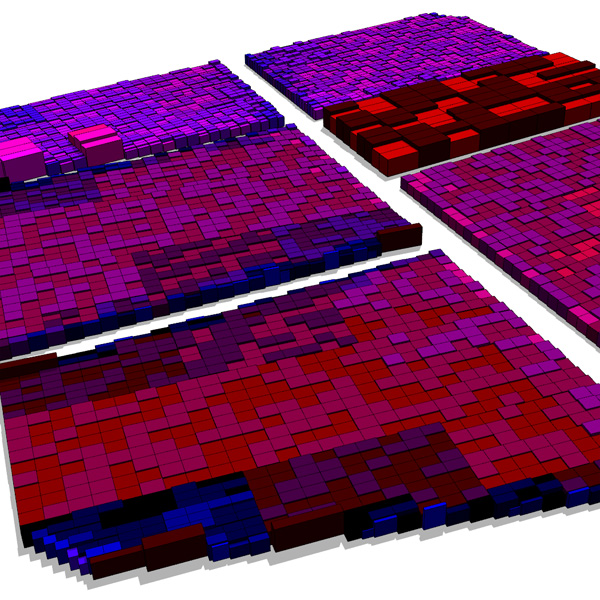
Insert -->
    alignScopeToAxes(y)
    i(assetApproxSize("/myProject/assets/cube_*.obj", "xz", 2))
n=3: "choose randomly one of the best three fits"
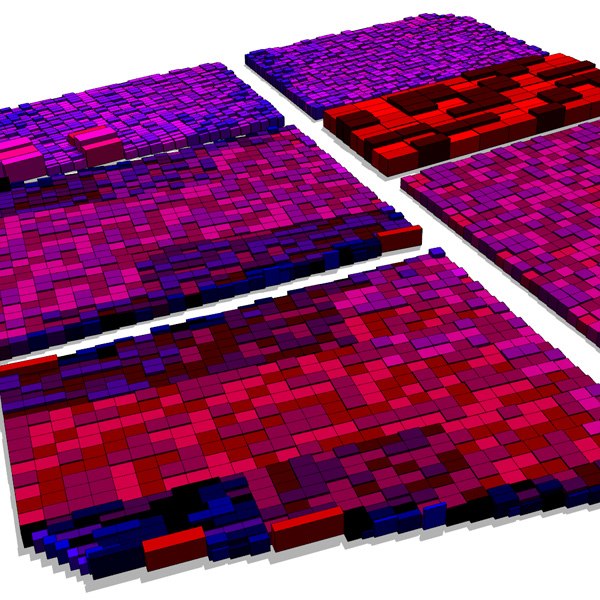
Insert -->
    alignScopeToAxes(y)
    i(assetApproxSize("/myProject/assets/cube_*.obj", "xz", 3))